Buffered to Bits
James Huemoeller & Thomas Hogge
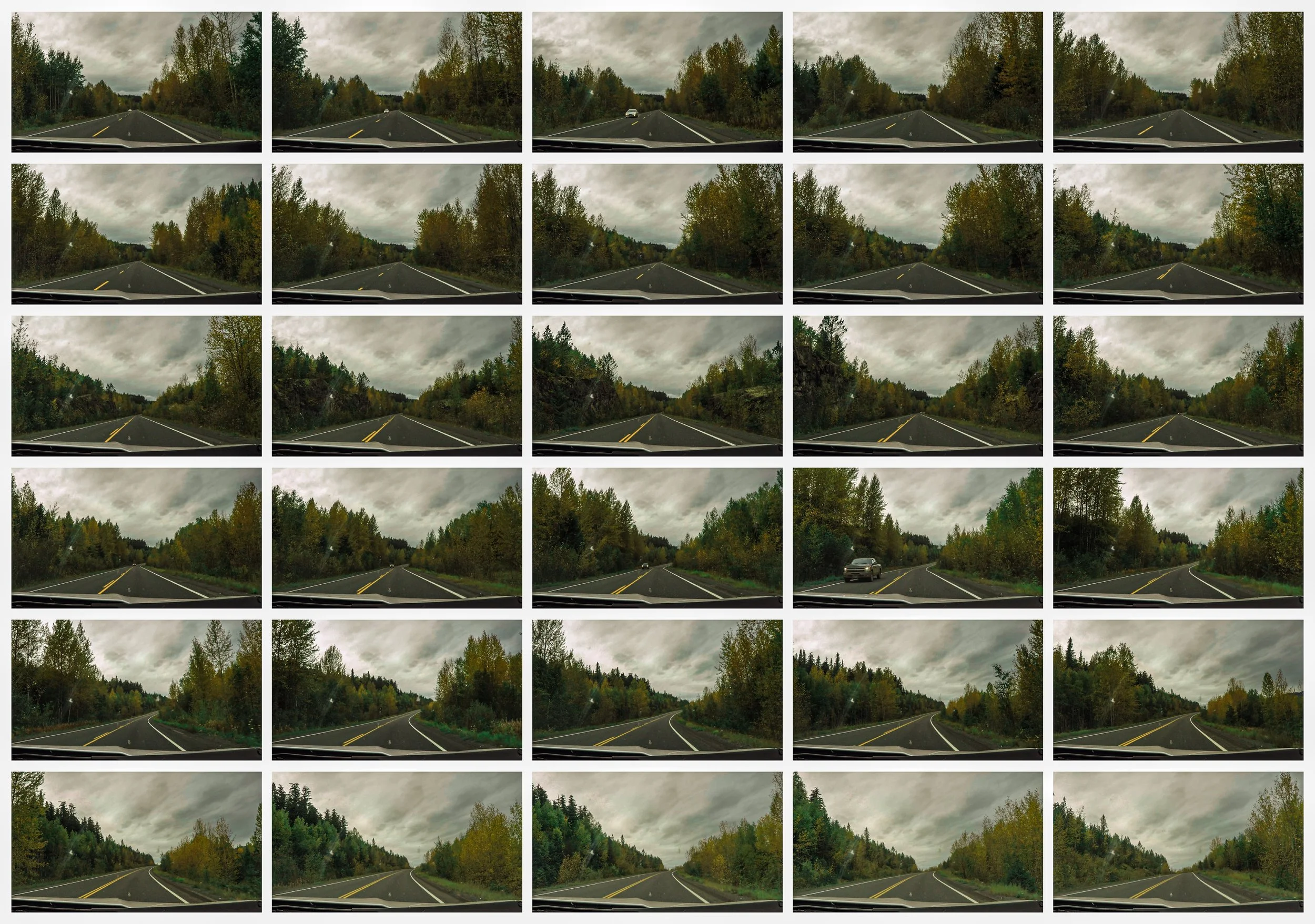
Drive north from the populated border between Canada and the US, the landscape quickly gives way to unrelenting boral forests. The beautiful monotony of this landscape, devoid of clear landmarks, obscures distance and place. A never-ending line of trees moves past like a scene from an old Hollywood movie: the contemplative protagonist drives off into the primal embrace of a robust and dense forest.
Thin veils
But all is not calm. An aerial view of the territory shows the unending forest to be just a narrow band of trees. These “buffer forests” conceal the impacts of an extractive lumber industry and suggest untouched wilderness instead of industrial cutblocks, fragmented drosscapes,[i] and deforested waste lands just beyond the screen.[ii]
Forestry will be a critical industry as wood becomes a key actor in a sustainable future.[iii] But these buffers obscure a full accounting of ecological and cultural impacts of its practices, deluding and distancing the public, and distracting the potential of collective, communal pressure to reform and improve its practices.[iv] We build with geologic-scale impacts but seem to remain ignorant of the consequences. The farce of these thin buffers isn’t just spatial; ecological function is reduced or more often eliminated.[v]
Buffer strips
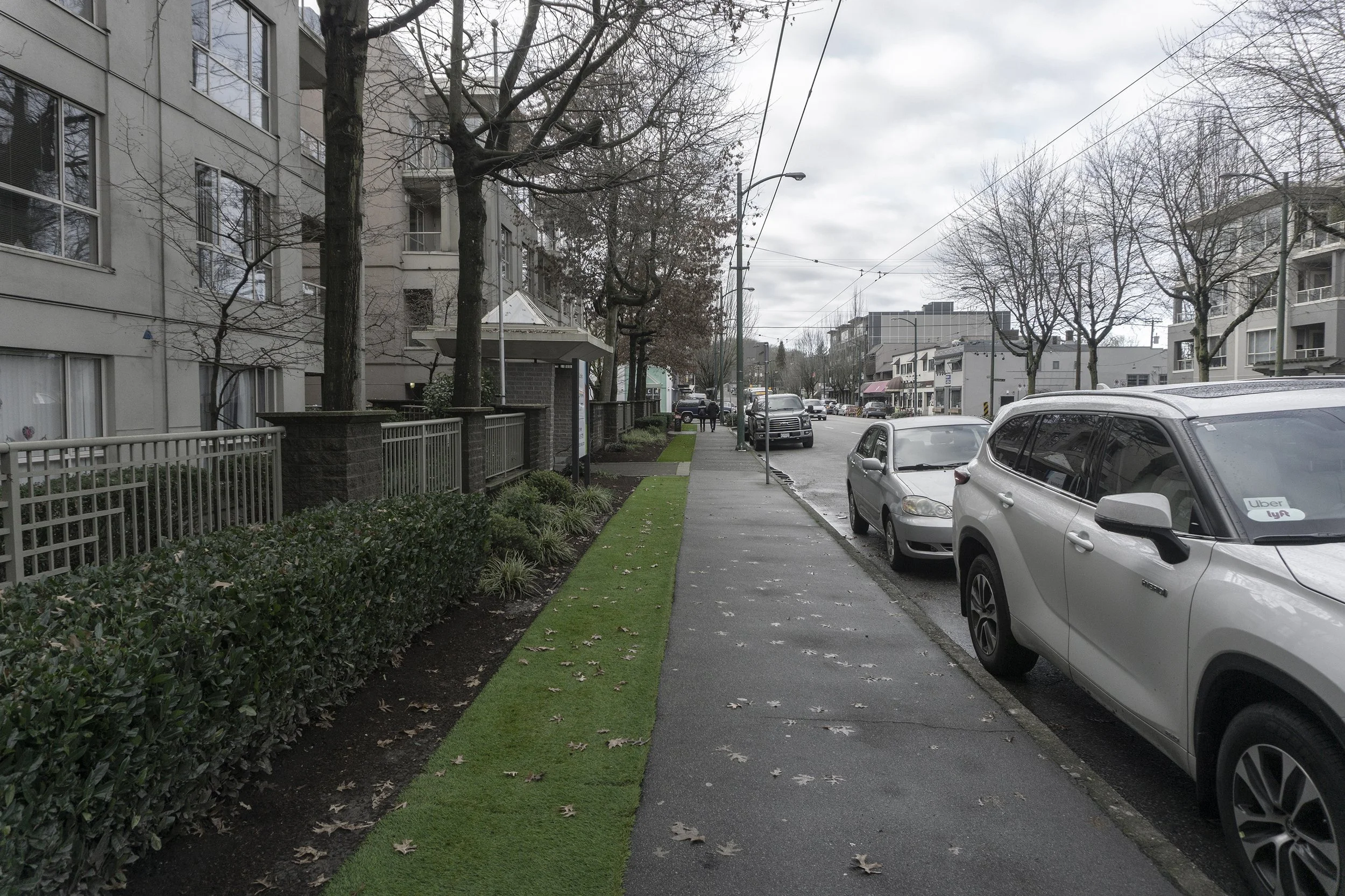
The issues are similar in our cities. Policy and zoning requirements limit the value of the edge and the productivity of public space. Calculating the area of land lost to grassy strips in Vancouver, for example, reveals a process of city making disconnected from the intensity of urban places that hold our imagination. Instead of diverse zones of mixing and exchange, our cities use edges to isolate and separate.
Recent developments downtown in False Creek emphasize this point.[vi] Too much of the land holds neither buildings nor sufficient space or program for meaningful public use. A tower/buffer relationship replaces the archetype tower/podium model. These vague terrains meet the requirements of city planning doctrines but become ecological and cultural dead zones: mown buffers green the city but contribute little value, leaving a sprawling development of dense towers and disconnected landscapes as its residue.
This disparity is comically reinforced when real life sets in. Relentless rain and the trampling feet of disobedient urban actors create muddy channels. Eventually, artificial turf replaces the grass. These unprogrammed strips demonstrate a failed urban model, not the anthropogenic harmony with nature they seem intent to celebrate. In an animated city, functional edges (and the thresholds they form) are critical. Buildings meet streets with purpose. Expansive landscapes form by design not as non-building remnants. Buffer zones represent some desire to segregate good and bad.
Such divisions might be easy or make us feel better about the world. But don’t we know better? Or have our North American cities used such buffers so exhaustively that we can no longer imagine alternatives?
Architects often accept these zones as fixed and even design their proliferation. Visions of “green” future cities still show shiny architectural objects on green carpets traversed by transportation networks, models that owe far more to early 20th century ideas than to robust understanding of ecological or urban futures as thin veneers of green rather than the rich environments we desire.
What does a future city look like if we confront rather than conceal our messes? What if we focused not on density, but on designing for intensity?
Don’t waste space
Every square inch of our world matters. We cannot continue to install meaningless strips of fallow topiary. Far from harmless, ineffective buffers represent a wastefulness and, worse, a lack of curiosity and creativity in the policy-making arms of our cities that we must resist.
To meet the challenges of our time, we must demand more from our buffers and bureaucrats: more performance and more productivity. Can we bring all those little green strips together? We might have quite the nice park.[vii] Or can we consolidate cutblocks at the outskirts of our cities? The relationship between lumber we use and forests we farm would be quite different. The slow recession of the forest would be rendered more vividly as our access to and view of “pristine nature” moves farther away with each day.
Thicker edges
Thick, spatially rich edges are important and have endless precedent.[viii] But too many of our new edges are vestiges of exclusion and concealment. They epitomize our failure to fully immerse ourselves into, and embrace, the complex dynamics that make this world interesting. Until we do so, our visions of sustainable urban futures will be a mirage, unlikely to move beyond empty ambition and green renderings.
[i] We’re drawing on Alan Berger’s definitive work and prompt for landscape and building architects to address the various forms of dross in our built environments.
[ii] Special thanks to Ada Sakowicz whose studio research contributed to this article.
[iii] The entanglement of innovative forestry practices, carbon dynamics, and scalability of applications for wood in the design of future cities is addressed more completely by Ibanez, Hutton, and Moe in Wood Urbanism (Actar, 2020).
[iv] Sustainable forestry practices currently depend on the myth that selective clearing simulates the role of fire prior to settler colonial disruption and later industrialization of forests for agriculture and development. Clearing does not contribute to soil nutrient cycling or the natural seed dispersal and germination instigated by a burn.
[v] Some jurisdictions mandate buffer distances, owing to “scenic character” or similar interests, but these are typically insufficient as productive forest edges, which operate as “ecotones,” zones of mixing and exchange between adjacent communities. Edges are thick, biodiverse, and dynamic zones layered with a range of vegetation and lighting conditions. Buffers are thin, and lack density or diversity. Some edges, especially at roadsides and areas of recent disturbance, promote invasive species, which come to have other particular values as food sources and habitat for prey animals,
[vi] False Creek sits between Chinatown, BC Place stadium, Science World, and the inlet that gives the district its name. The area extends developments in downtown of the last twenty years that have put Vancouver’s urban planning on the map. False Creek is the primary land connection between downtown and the rest of the city.
[vii] Of course, in designing these remnant landscapes, we would not propose the sort of dispossession perpetuated by Olmsted and others with the construction of Central Park, but something more aligned with the attitude of Gordon Matta-Clark’s Odd Lots, questioning the inefficient zoning requirements or ownership loopholes that leave fallow edges. We wonder specifically about redistributing or networking these spaces to increase their productivity.
[viii] We should acknowledge here the productive, dynamic buffers and repurposed medians, such as those at Argyle Street in Chicago (IL), a shared-street model that builds on the stormwater-focused landscape infrastructure retrofits of Portland’s (OR) Green Streets initiatives that began in 2003. But we’re equally interested in the entanglement of landscape boundaries with architectural edges at the ad hoc developments of cultural spaces like Hong Kong’s Apliu Street Market and Rio de Janeiro’s Ipanema Beach; and the ways in which thick porches and edges at the Centre Pompidou in Paris and the Kimball Art Museum in Houston recall the colonnade of St. Peter’s Square (especially prior to the demolition of the surrounding neighborhood by Mussolini in the early 1930s) or the Haengrang typology mixing civic and ceremonial public spaces in South Korea.