
Surrey Park Washroom Highlighted by Local Paper
The design intent for the Park Washroom prototype is to create a playful, durable, safe facility that works well within the various park contexts in the City of Surrey. The design employs a distinct form, strong colours, and unique use of materials in an attempt to change the public perception of how a park washroom should look and feel like. At the same time, the building materials and systems are designed to make the park washroom safe, secure, durable, and cost effective. Flexibility and sustainability are two other features of the design that contribute to its resilience. Below is a list of project goals which will all be touched on in more detail at the end of this section.
CHALLENGE THE COMMUNITY’S PERCEPTIONS OF WHAT A PARK WASHROOM CAN BE:
CREATE A PLAYFUL STRUCTURE
USE THE WASHROOM AS AN ORIENTATION/WAYFINDING DEVICE FOR THE CITY.
USE A RICH MATERIAL PALETTE
DURABLE/SUSTAINABLE/COST EFFECTIVE:
INCORPORATE PARK OPERATIONS STANDARDS AND LESSONS LEARNED
FOLLOW BTA, PHLUSH, ETC. RECOMMENDATIONS
PROVIDE NATURAL LIGHT AND VENTILATION
SAFE & SECURE DESIGN
INCORPORATE PARK OPERATIONS STANDARDS AND LESSONS LEARNED
FOLLOW BTA, PHLUSH, ETC. RECOMMENDATIONS
CREATE ACTIVITY THROUGH EXPANDED PROGRAMMING
FLEXIBLE DESIGN
PROVIDE SEVERAL CONFIGURATIONS FOR 1 OR 2 UNITS
ACCOMMODATE BOTH SERVICES AND OFF GRID SITES
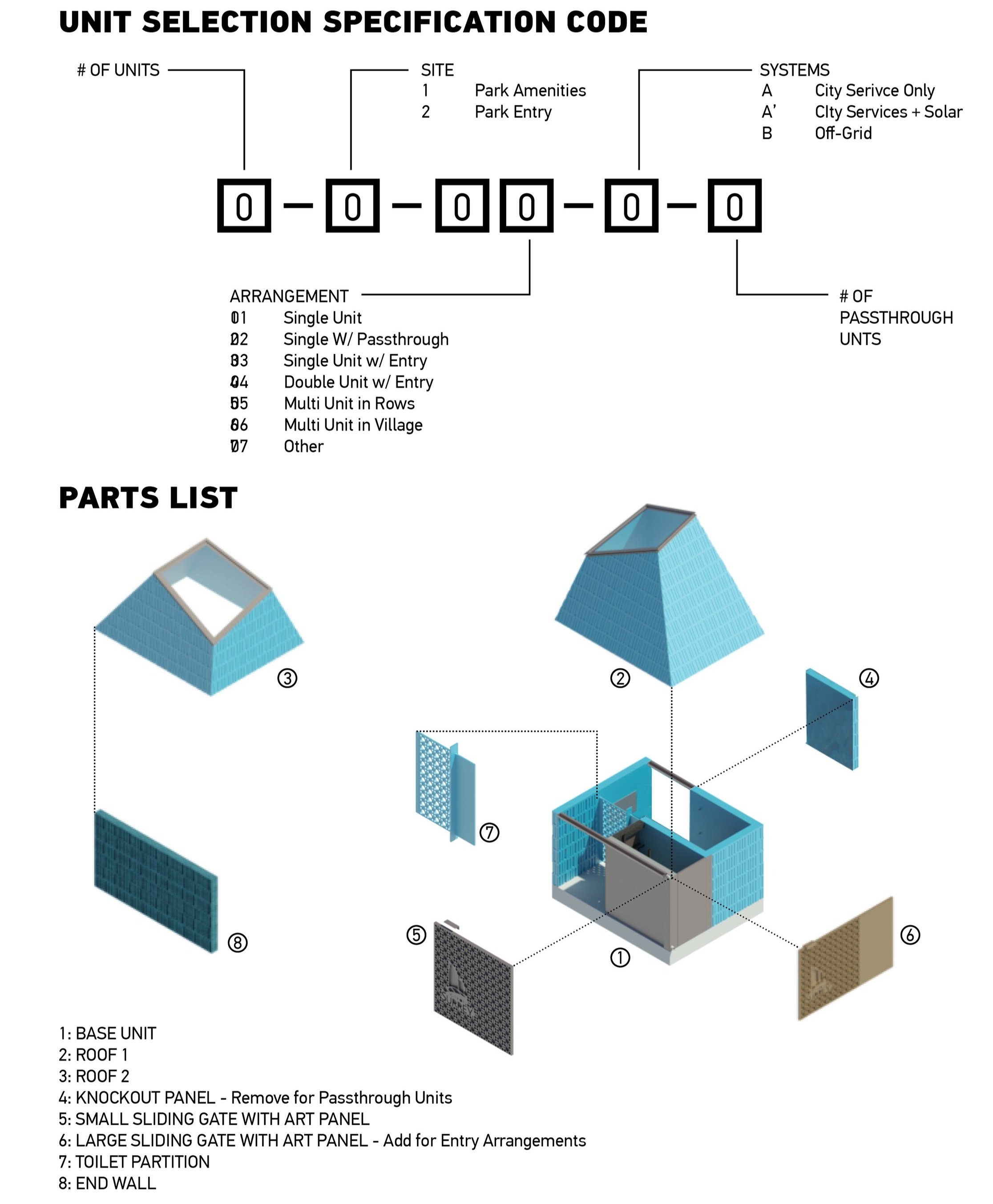
DESIGN FEATURES
The proposed design is for an 11 m2 (120 sf) park washroom that can be configured in a variety of ways. The form of the unit ensures that the roof is sloped to prevent camping at the more isolated installations, with a glass top to provide natural light to the interior.
FORM: The form of the building is driven by two things. One lesson learned from previous washroom projects in Surrey is that flat roofs invite climbing and camping. Therefore, the roofs had to be sloped to prevent any climbing. With that in mind, the design looks to provide a playful take on the sloping roof using some non-traditional slopes including a glazed surface that provides daylighting.
LAYOUT: The layout of the bathroom is divided into three separate spaces: a wash area, toilet area, and service chase. The wash area is separated from the main toilet area by a simple toilet partition. The separation of these two areas keeps the wash area clean and reduces wait times during particularly busy periods.
All the fixtures are arranged around the service chase to maintain a secure location for the plumbing. The wash area will house either the hand wash/dryer unit alone or both the hand/wash dryer unit and a foldable changing station depending on the configuration of the unit.
The toilet area houses a waterless urinal and toilet. It also will contain a foldable changing station (in some locations), a toilet paper dispenser, two (2) robe hooks, and the sanitary napkin receptacle. The sanitary napkin receptacle uses a small chase to send refuse to a fire-resistant container located in the service area. The chase is accessed through a small flap on the face of the wall.
The service area provides limited storage and houses all mechanical services. It also provides access to the soap dispenser for refilling the unit and for emptying the sanitary napkin receptacle. For units without water a large bin will be installed in the service area for the decomposition toilet. The service area will also contain shelving for the batteries for the PV installation, the inverter, meters and a hose bib and outlet for cleaning.
PUBLIC ART PANEL: To promote the public arts program and bring more community involvement into the project, the design provides space on the entry gate for a laser or plasma cut, steel panel. The panels will be 6’ - 6” square with a finish to match the adjacent steel wall panels, either weathering steel if the concrete is coloured, or a powder coating steel finish used in conjunction with grey/white concrete. The panel will be procured by the Arts Division, and the installation handled by the City. In lieu of an art panel, the unit would have solid metal panels.
WAYFINDING & COLOR CODING: Contemporary urban wayfinding is about building a wider range of visual, audible, and tactile cues into streetscapes and buildings. Two important principles include creating a distinct identity at each location and using landmarks to provide orientation cues. Design techniques to enhance wayfinding at a ‘macro’ scale include a built form pattern and streetscape design that reflects the hierarchy of streets, landmark buildings and memorable open spaces at key places in the movement network, and building and streetscape design that contributes to a distinct character in each precinct. There are two types of urban wayfinding tools, active and passive. Active tools include urban interventions and landmarks while passive tools include water features, vegetation, views, spatial organisation, and program.
The intent of the Park Washroom design is to use colour as a wayfinding cue for the City of Surrey. Ideas include using distinct colours for each town centre, different colours for the type of park, or different colours for the type of amenities available at each park. In either case, the colour of the facility would serve as a visual marker within the urban landscape of Surrey, i.e. “When you see the bright red building turn right” or “I see a red park structure, so I must be in Cloverdale.”
FABRICATION: The intent is for the unit to be fabricated off-site as much as possible to minimise the impact on the parks, promote replicability, and maintain a high level of quality. The exact form of fabrication of the unit, including the extent of concrete vs. steel, will be left to the discretion of the builder, provided the design intent be maintained.
CONCRETE: The primary building material used for the design is concrete. Concrete provides sufficient durability, can handle moisture, and is a flexible material. Over the last 20 years, the capabilities of concrete fabricators have changed dramatically. No longer is concrete simply a grey, hard material, but one that can take on an infinite array of variety and colour. The project uses the full potential of contemporary concrete fabrication techniques including strong patterning, colour additives, and new mix designs. Where the unit requires privacy, the concrete will be solid, but to allow more daylight penetration and natural ventilation other areas will have small openings within the pattern.
To meet the City’s sustainability objectives, the project seeks to utilise as much recycled content in the concrete mix design as possible with a goal of 100% of the aggregates from recycled content. As the project will be precast, a high level of finish is anticipated. However, some discolouration or other defects should be tolerated due to the ambitious goals with the mix design.
PV SYSTEM: The PV panels will be integrated into the concrete structure or act as Building Integrated Photovoltaics (BIPV) as its known within the solar industry. The full integration of the solar panels will address two issues. One, the panels will be recessed into the concrete and thus more secure from theft.
The second is that traditional solar panels would not meet the aesthetic goals of the project given their tendency to stand out on roofs, especially small ones. The solar panels will be custom 1’ x 1’ panels with 6” x 6” colour solar cells to match the concrete finish mounted on toughened glass.
SYSTEMS & SERVICE: There are essentially two versions of the basic module regarding systems. One with water and another without for installations where connections to the City’s services are not feasible.
OPTION A - CONNECTION TO CITY SERVICES:
ELECTRICAL LOADS
50 W Heat Trace
3100 W Hand Dryer
50 W LED Light
1200 W Convenience Electrical Outlet
PLUMBING EQUIPMENT
Stainless Steel Toilet
Stainless Steel Waterless Urinal
Recessed Handwashing Station with Integral Soap Dispenser & Hand Dryer
OPTION B - OFF-GRID:
ELECTRICAL LOADS
50 W LED Light - Code Requirement
1200 W Convenience Electrical Outlet
PLUMBING EQUIPMENT
Decomposition Toilet: Toilet with a conveyor that feeds a bin in washroom unit chase. The toilet would include a foot and hand pedal to activate the conveyor. Signage would be required to explain the use of the fixture.
Waterless Urinal
Recessed Hand Sanitizer
SITING: As mentioned previously maintaining visibility to the unit is the primary consideration for siting the units. Having the entrance to the toilets facing a street or parking lots provides natural surveillance. Large open spaces with short cuts or locations where children can play should be avoided.
The design team identified two possible locations for siting the unit. A location near the respective park’s site amenities such as playing fields, parking lot, or picnic areas is likely the most common option. A location near any playgrounds is not recommended.
The second option is near the park entry. This site would likely be used where there is a clear entry to a park or where the park’s layout does not provide a location with good visibility. It would probably involve the lowest site development costs due to the proximity of services.
ARRANGEMENT: The are many options for arranging the units on a site. Below are six identified by the design team.
01 - SINGLE UNIT: The simplest option is, of course, a single unit.
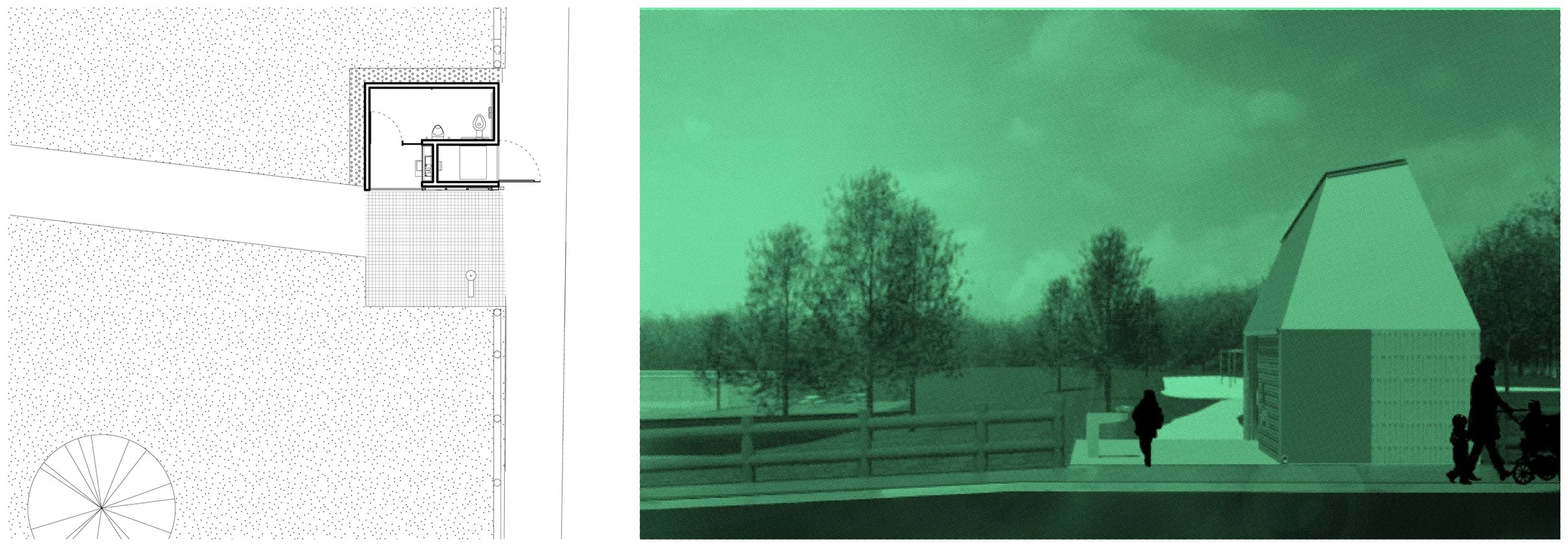
02 - SINGLE UNIT WITH PASS-THROUGH: The partition separating the wash area from the toilet is can be installed in one of three locations. The first option is shown in the previous iteration with the single stall unit. The second option would move the door forward to bring the wash space together with the toilet area. The final option move the door next to the urinal with an expanded wash area. In the latter case an opening could be created on either end of the wash are providing a more open space with a passthrough.
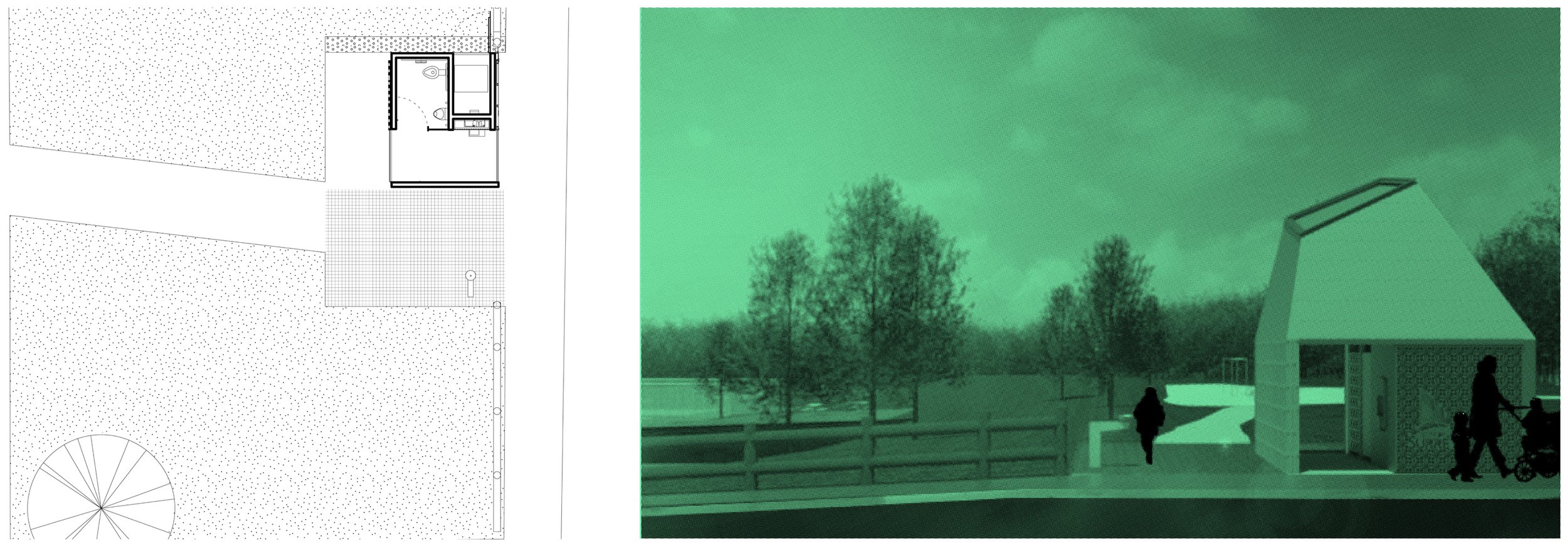
03 - SINGLE UNIT WITH ENTRY: In this configuration an entry with an open roof is adding to the standard unit. Here instead of a sliding door at the front of the unit, a sliding door is added to either side of the unit that can be shut down at dusk. Although the configuration could work without the roof, the roof provides security by preventing individuals from climbing the gate to enter the facility when closed. The configuration works both alongside the park amenities or a walkway, or across a walkway at a park entry.
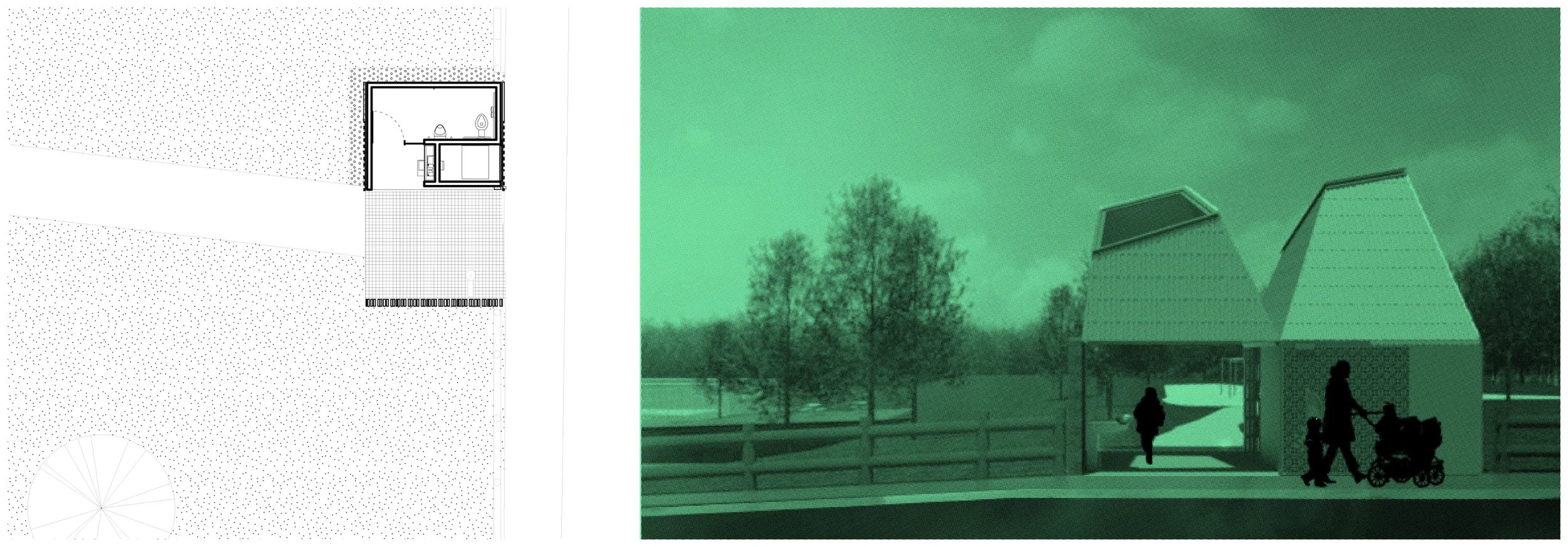
04 - DOUBLE UNITS WITH ENTRY: In this configuration, as with the previous option there is an entry with an open roof that serves both units. When the facility is shut down gates on either side of the entry are slid shut and locked. As with the previous option, this configuration can sit alongside a public amenity space or walkway or across a walkway, especially at the park entry.
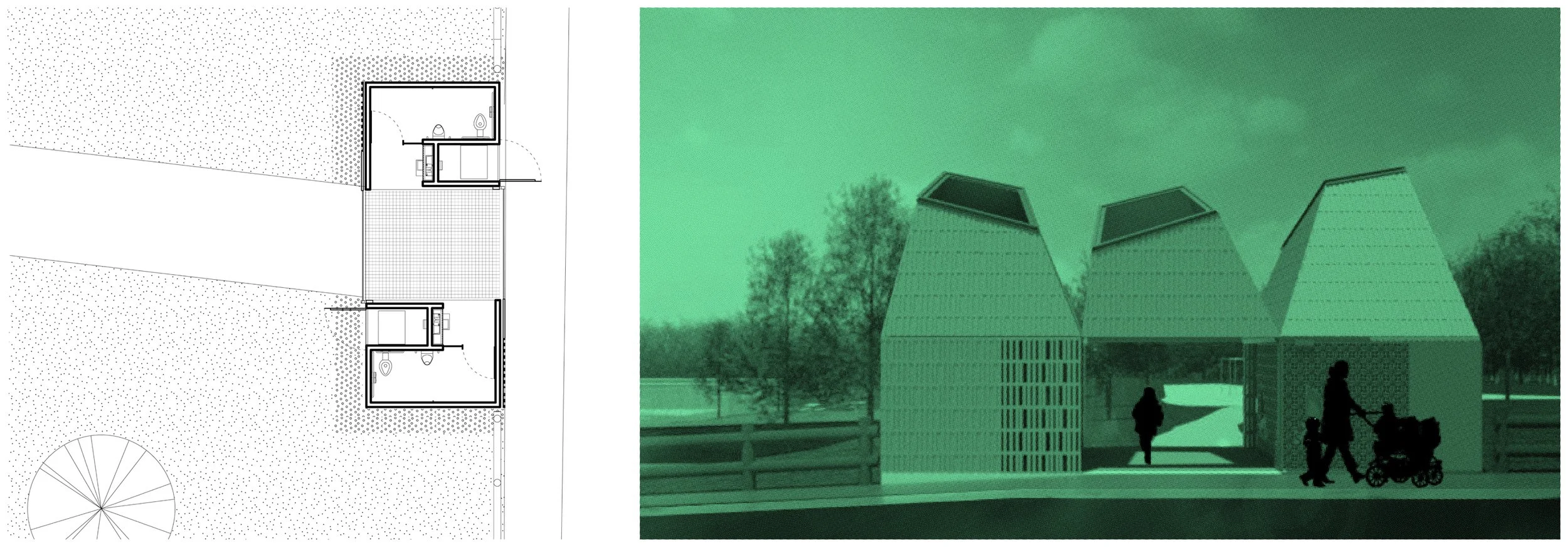
05 - DOUBLE UNITS IN ROWS: There are several options for arranging multiple units, the first being aligning the units in a simple row. Here every other unit would have a different roof type in order to provide a little more variety between the units and give the washrooms more visual interest. There would also be the benefit of coupling the systems to reduce cost. Obviously all of these options could also include variations within the individual units.
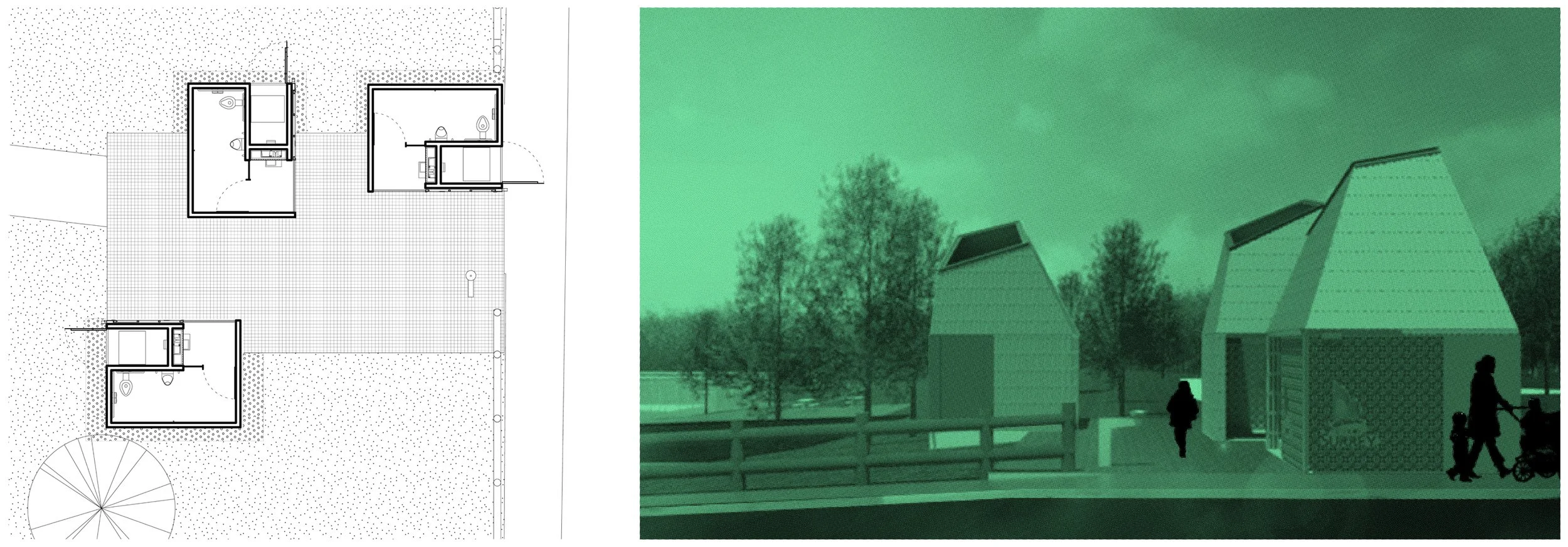
06 - DOUBLE UNITS IN VILLAGE: A second arrangement of the units would be a village arrangement around a central path or space. Again, alternating roof forms would provide variation.
DESIGN GOALS
DURABILITY: Public facilities should last. The durability of the facility played a major role in the design of the washroom. This requirement is reflected most obviously in the choice of concrete and steel as the primary materials for the project. Most washrooms in urban environments are built out of one of these two materials for a reason.
In addition to the choice of materials, the detailing of the facility takes into consideration the durability of the structure. The design sought the elimination of any edge that could be grasped or pulled except the gutter at the entry.
SECURITY: The security of the facility also played a major role in the design of the washroom. Although the siting of washrooms by the Parks District tries to place the units in conspicuous locations, there are still significant concerns as to the security of the units. There are three aspects of security that influenced the design of the unit.
The first is that the units needed to be vandal resistant, including, but not limited to being fireproof, having graffiti resistant surfaces, recessed specialties or fixtures and a secure chase space for services. The concrete finish surfaces are both flame and graffiti resistant.
The second aspect is that the unit needs to provide visual transparency as much as possible, both to prevent vandals and to make sure the users feel safe using the unit. The perforated concrete walls, and partition door open to unit to allow the City’s staff to see inside the unit without invading the privacy of the users. These same features give the unit a more open feel. The proposed arrangements including the pass-through also enhance the visual connectivity for the units. The last consideration is the unit needs to prevent camping. As mentioned above the sloped roofs and secure sliding gate should prevent occupants after hours from hoteling in the unit.
SUSTAINABILITY: The City of Surrey and the Parks Divisions have ambitious sustainability goals as stated in the City’s Sustainability Charter 2.0 and the Community Climate Action Strategy which seeks GHG reductions and climate adaption. In light of these initiatives the project looked for every opportunity to improve the sustainable performance of the project. As fire concerns eliminated rapidly renewable materials from the project, the design looked closely at reducing the use of raw materials for the project. Both the structural steel and the concrete will make use of recycled materials. The concrete in particular will consist of fly ash as a partial replacement for cement, and 100% recycled aggregates. Low VOC sealants and coatings are specified throughout.
The systems will also have several sustainable features including the incorporation of a Photovoltaic systems on the roof and the use of low flow or waterless fixtures. Given the climate of Surrey, especially in the winter when electrical demand is at its highest, a fully equipped module will rely on the grid, however the design will strive to achieve a net-zero energy use. Where the Option B systems are installed, the module will also contribute no waste load to the sanitary sewer system.
FLEXIBILITY: The unit is designed to accommodate a variety of different installations and arrangements for the different parks in Surrey. Within the unit, it is possible to locate the toilet partition in several areas and there are two options for systems/services. There is also flexibility in the arrangement of the units, with 6 types shown.